Honeycomb honey is considered one of the purest and least processed types of honey that comes to mind when talking about natural honey. However, not every honey sold with the “honeycomb” label truly possesses these qualities. The differences between natural honeycomb honey and honeycomb honey are often confused, making it difficult for consumers to distinguish genuine honeycomb honey. In this article, we will discuss the characteristics and benefits of honeycomb honey, and answer the question “How to distinguish fake honey?” with scientific and practical information, addressing the key points that differentiate genuine honeycomb honey from other types of honey.
What is Dark Hive Honey? The Natural Story of Dark Hives
Dark comb honey is a traditional bee product where human intervention in beekeeping is minimized, and honey production takes place while preserving the bees’ natural behavior. This type of honey is produced in hives where the bees build their own combs using their own secreted beeswax, without being given ready-made combs. In this respect, dark comb honey differs from honeys obtained through industrial methods in both its production process and content.
Free from Human Intervention: Traditional Basket Beekeeping
Traditional basket beekeeping, unlike modern frame hive systems, is a beekeeping method that does not direct the bees in the production process. In this system, the beekeeper does not place ready-made combs in the hive; foundation combs, wax plates, or wire frames are not used. The bee builds its comb entirely with its own secreted beeswax, according to its instinctive architecture. This allows the honey to mature by constantly being in contact with natural beeswax, pollen, and propolis.
One of the most important differences in basket beekeeping is that feeding and harvesting control are kept to a minimum. In the traditional basket hive system, bees are not given sugar syrup; the colony is not supported with external resources during the honey flow period. Also, early harvesting is not done; the honey is left in the hive until it reaches the bees’ natural moisture balance. This process allows the honey’s aroma profile to deepen and its enzymatic structure to be preserved.
Why “Black” Hive? The Effect of a Dark Environment on Honey Quality
The word “dark” in “karakovan” (dark hive) refers to the enclosed, dark structure of the hive. Traditional karakovan hives are usually made from tree trunks, reeds, or natural materials, and their interior is dark. This dark environment creates the closest possible conditions to the bees’ natural nest.
In lightless hives, bees work more calmly, stress factors are reduced, and the honey ripening process progresses more steadily. This contributes to karakovan honey having a more intense aromatic structure, a firmer texture, and a more pronounced taste. Produced under natural conditions without haste, this type of honey differs from other types of honey in both flavor and content.
How to Identify Authentic Honeycomb Honey? 5 Practical Methods
Distinguishing authentic honeycomb honey isn’t possible simply by looking at the label or focusing on a single characteristic. Because honeycomb honey doesn’t follow a standard production method, each batch can have a different appearance and aroma. Therefore, accurate evaluation requires examining multiple criteria together, from the honeycomb structure and aroma to the taste and analytical values. The following methods include both practical tips that consumers can observe at home and the most reliable indicators based on scientific verification.
Examine the Honeycomb Structure: Could Perfection Be a Sign of Fakeness?
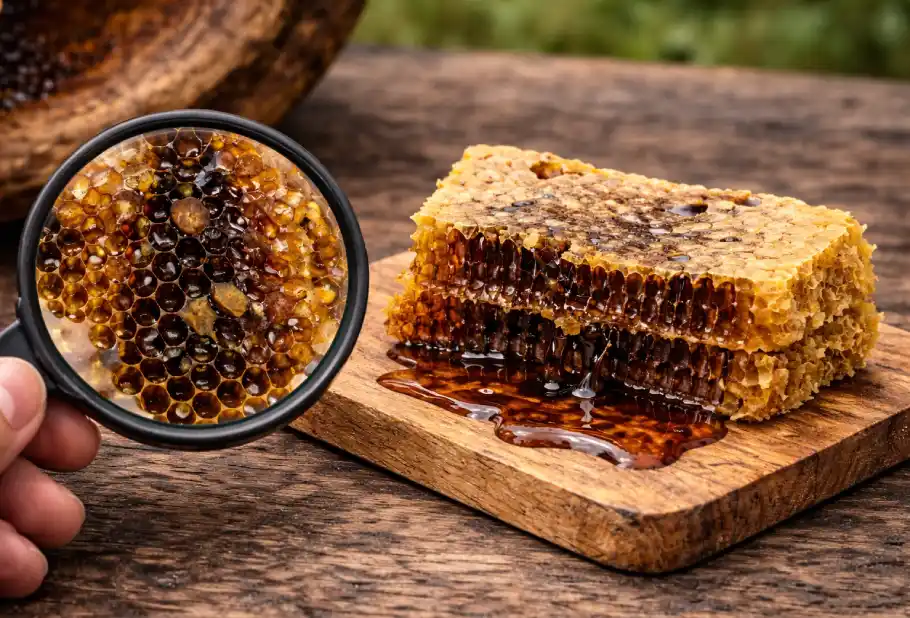
In genuine honeycomb honey, the honeycomb structure is asymmetrical and irregular. This is because the bee builds the honeycomb entirely with its own beeswax and natural instinct, without using pre-made molds. The size of the honeycomb cells may vary; the edges may appear rough, and the surface may seem wavy. In contrast, honeys using factory-made foundation combs generally have honeycombs of the same size, symmetrical, and with a regular hexagonal structure.
The Natural Beeswax Dissolves in the Mouth Test
The beeswax in genuine honeycomb honey softens and crumbles in the mouth when chewed, and does not remain rubbery for a long time. After chewing for a while, it dissolves in the mouth and leaves a light herbal aroma.
The beeswax used in fake or foundation comb honeys, on the other hand, remains hard in the mouth, stretches like gum, and stays in clumps without dissolving. This is a sign that the beeswax may not be a natural secretion; it may be processed or adulterated.
Aromatic Scent and Taste Intensity
Genuine honeycomb honey has an intense and layered aroma that directly reflects the flora of the region where it is produced. Following the initial sweetness, floral, herbaceous, and sometimes slightly resinous notes are perceived. The taste lingers in the mouth for a long time and is not one-dimensional.
In contrast, fake or syrup-fed honeys:
- The taste comes and goes quickly.
- It leaves only a sugary sensation in the mouth.
- The scent is usually weak or artificial.
What Do Honey’s Color and Transparency Tell Us?
The color of genuine honeycomb honey can range from light amber to dark brown, depending on the flora. However, a common characteristic is that the honey is not completely clear. It may contain natural pollen particles and beeswax fragments. Excessively bright, glass-like transparent honeys are often filtered, heat-treated products whose natural structure has been altered.
The Most Definitive Answer: Proline Value and Analysis Reports
While all sensory tests are important, the clearest answer to the question “How to distinguish fake honey?” is laboratory analysis. In these analyses, the proline value is a particularly important indicator. Proline is a natural amino acid that bees add to honey and indicates the honey’s maturity level. A low proline value strengthens the possibility of sugar feeding, early harvesting, and artificial additives.
Key Differences Between Traditional Honeycomb Honey and Other (Modern) Honeys
The difference between traditional honeycomb honey and modern honey lies in the freedom given to the bees, the maturation process of the honey, and the resulting biochemical structure. Modern honey refers to controlled production in modern framed hives, while traditional honeycomb honey is a type of honey produced by the bees’ natural instincts with minimal human intervention.
The Difference Between Foundation Comb and Honeycomb: The Bee’s Own Wax Construction
In conventional honey production, bees are often given ready-made foundation comb. These combs are created by molding previously melted beeswax, speeding up the bee’s honeycomb building process. The aim is to increase production and standardize the comb structure.
In traditional honeycomb honey, however, no ready-made comb is provided to the bees. The bee builds its own comb entirely with its own secreted beeswax, following a natural comb architecture. This process:
- Requires more energy
- Takes longer time
- But increases the contact of the comb with natural beeswax, propolis, and pollen
Thus, traditional honeycomb honey becomes a reflection of all stages of the bee’s biological production.
Sugar and Additive Use: The Zero Intervention Principle
In conventional honey production, feeding bees with sugar syrup is a common practice, especially during periods of weak honey flow. This doesn’t always mean fake honey, but it can indirectly affect the natural nectar-derived content of the honey.
In traditional honeycomb honey production, however, the fundamental principle is zero intervention. Bees are not given sugar, glucose, or similar nutrients. Honey is formed solely from the nectar that the bee collects from nature. This approach:
- Enhances the aroma profile of honey
- Prevents sugar-induced dilution
- Preserves the natural enzyme balance of honey
Therefore, honeycomb honey prioritizes naturalness and purity over quantity in its production process.
Comparison of Nutritional Values and Enzyme Richness
The nutritional value of honey is determined by its enzyme, amino acid, organic acid, and pollen content. Processed honeys may lose some of these components during filtration and sometimes heating processes.
Honeycomb honey, on the other hand, is not subjected to heat treatment, intensive filtration, and largely retains its natural pollen and enzyme structure. This explains the digestive support, immune boost, and intense aromaticity benefits of honeycomb honey. Its rich enzyme content makes honeycomb honey a natural nutritional matrix.
Health Benefits of Honeycomb Honey: Why Choose This Honey?
Honeycomb honey is considered a functional food that largely preserves its nutritional components thanks to its production method. The absence of ready-made honeycomb, sugar feeding, and heat treatment directly affects its biological value.
Digestive System Friendly: Stomach and Intestinal Health
The effects of honeycomb honey on the digestive system are related to its natural enzymes and raw form. This honey, matured by bees, does not contain refined sugars that make digestion difficult; on the contrary, it contains components that support a more balanced digestive process in the stomach and intestines.
Especially when consumed in its natural honeycomb form, chewing the honey along with the honeycomb increases saliva production and initiates digestion from the mouth. This contributes to balancing stomach acid and more regular bowel movements. This is the main reason why honeycomb honey is traditionally preferred for its gentle nature on the stomach.
Natural Antioxidant and Antibacterial Protection
The antioxidant and antibacterial effects of honeycomb honey stem from its production without heating or filtration, and by allowing it to mature in the bees’ own beeswax. This production method ensures that the honey remains rich in phenolic compounds, flavonoids, organic acids, and enzymes.
In particular, phenolic compounds and flavonoids are natural antioxidants that limit the effects of free radicals, which cause oxidative damage in cells. While filtration and heat treatment in commercially produced honeys can reduce some of these components, these substances are largely preserved in honeycomb honey. This makes honeycomb honey not only an energy-providing food but also a nutrient with protective potential at the cellular level. The antibacterial effect arises from the combined action of several mechanisms. Honeycomb honey;
- Low pH value
- High osmotic pressure
- Low levels of hydrogen peroxide produced by glucose oxidase enzyme
- Natural organic acids
It creates an environment that makes it difficult for bacteria to multiply. This effect is not aggressive like that of synthetic antibacterial agents; it has a limiting structure without disrupting the balance of microorganisms.
Immune System Support in Children and Adults
The relationship between honeycomb honey and the immune system is explained by the pollens, enzymes, and natural micro-components it contains. These components provide the nutritional support necessary for immune cells to maintain their normal functions.
In children, it helps meet energy needs naturally, especially during growth periods; while in adults, it can contribute to maintaining immune balance during seasonal changes and busy periods. The important point here is that honeycomb honey should be consumed regularly but in moderation. Not excessive amounts, but natural and balanced consumption should be the basis for immune system support.
Why is Honeycomb Honey More Expensive Than Other Honeys?
The price of honeycomb honey makes sense when considering its production method, time cost, and the biological value of the resulting product. Compared to other (artificially produced) honeys, honeycomb honey is produced in smaller quantities, requires more labor, and cannot be standardized. These factors make honeycomb honey a more limited and therefore more valuable product in the market.
Challenging Production Conditions and Low Yields
In traditional honeycomb honey production, beekeepers consciously abandon many yield-enhancing practices used in modern beekeeping. Ready-made foundation combs are not used, sugar feeding is avoided, and honey harvesting is not accelerated. The bee builds its comb entirely with its own beeswax and matures its honey in its natural cycle.
Compared to the amount of honey that can be obtained in a season from conventional hives, the honey obtained in the traditional hive system is much more limited. Moreover, not every hive produces honey every year; weather conditions, flora richness, and colony health directly affect the result. From the beekeeper’s perspective, this means a longer production period, higher risk, more labor, and consequently, less product.
The Value Created by Pure and Natural Ingredients
Another factor that increases the value of traditional honeycomb honey is that the production process preserves the nutritional and enzyme structure of the honey. The absence of heat treatment, intensive filtration, and the maturation of the honey within the natural comb ensure that enzymes, pollens, and aromatic components are largely preserved.
This makes honeycomb honey a functional food with high biological value. However, this quality cannot be replicated or standardized through mass production. Each batch, each hive, and each season has a different character.
Therefore, the price of honeycomb honey is determined more by the production method, level of naturalness, time, and patience involved, rather than by the weight.
Frequently Asked Questions About Honeycomb Honey
Does honeycomb honey freeze (crystallize)?
Yes, genuine honeycomb honey can crystallize over time. This indicates that the honey is natural and unprocessed; it does not mean spoilage or imitation. Crystallization can vary depending on the honey’s glucose content, pollen content, and storage temperature.
What does raw honeycomb honey mean?
Raw honeycomb honey is honey presented to the consumer without heating or filtration. This preserves the honey’s natural enzymes and aromatic structure. The term “raw” indicates that the honey has not been processed and is considered a quality indicator.
Discover Authentic Honeycomb Honey at Cahter Organik
At Cahter Organik, we produce honeycomb honey without interfering with the bees’ natural life cycle, without using foundation combs, and without feeding them sugar. Our organic honeycomb honey, obtained from the high-altitude, rich flora of Siirt, is presented in its natural comb, with its intense aroma and pure content. All our products are guaranteed by regular laboratory analyses and certifications. To experience the naturalness and quality of authentic honeycomb honey firsthand, discover the unique taste of Cahter Organik honeycomb honey today.