While honey is often associated with the nectar of colorful flowers, nature offers us a far more complex and unique miracle: honeydew honey. Pine honey, one of the most valuable representatives of this category worldwide, is distinguished from flower honeys by both its production process and its components, making it a veritable remedy. Getting to know this special type of honey, in which Turkey is a world leader in production, allows us to understand the value of this delicious treat on our tables.
What is Pine Honey? A “Secretion Honey” Story
Honeys are basically divided into two main categories: “floral honeys” and “secretion honeys.” Pine honey is a secretion honey, the rarest and most valuable representative of this distinction. Unlike other honeys, it is not obtained by bees collecting nectar from plant flowers, but by collecting sugary liquids that are the product of a biological collaboration taking place in the trunks of trees.
This special honey, which can only be produced in a very limited geographical area worldwide, is known for its unique dark color, smooth taste that doesn’t irritate the throat, and woody aroma. Its “secretion honey” story elevates it beyond being just a food item; it becomes the fruit of a perfect ecosystem established between trees, insects, and bees. When its chemical structure is examined, it is seen to contain much higher amounts of minerals, amino acids, and enzymes compared to floral honeys.
Difference from Flower Honey: The Mysterious Work of Bees in Pine Trees
The fundamental difference between flower honey and pine honey begins with the quality of the source. In flower honey, the bee directly collects the nectar secreted from the flower’s reproductive organs. However, in pine forests, the process is much more complex. Bees shift their routes to the trunks of pine trees during periods when flowers are not shedding pollen or nectar is scarce.
Pine honey crystallizes (freezes) much later than flower honey. This is because its glucose and fructose content is lower than flower honey, while its mineral content is higher.
The Pine Coelous Moth (Marchalina hellenica) and the Honey Formation Process
Do bees produce honey directly from tree bark? No. This is where the insect known as the “Pine Coelous Moth” or “Pine Cottony Scale” (Marchalina hellenica) comes into play. So, how exactly is pine honey formed?
The process works as follows: The pine coelous moth feeds by sucking the sap from the trunk of pine trees (especially Scots pine). After passing through the insect’s digestive system, this sap is released onto the tree trunk as a carbohydrate-rich, colorless, and sweet secretion. This secretion is particularly concentrated between July and October. Bees collect this sap from tree trunks during this period when flower nectar is scarce. They process this substance with their own enzymes and store it in honeycombs, where it matures inside the hive, transforming into the characteristic pine honey we know.
Türkiye’s Leadership in World Pine Honey Production and the Muğla Region
Turkey is the absolute global leader in pine honey production, accounting for approximately 90% of the world’s reserves and production. The biggest factor behind this success is the favorable microclimates and extensive pine forests along the Aegean and Mediterranean coasts. The Muğla region, particularly the Marmaris, Fethiye, and Milas line, is considered the heart of pine honey production.
The high humidity and suitable temperature in the region provide an ideal environment for the efficient work of the pine beetle and bees. Honeys obtained from Muğla and its surroundings have strategic importance in the world market due to their high enzyme content and purity. This biological richness of Türkiye both ensures the preservation of local beekeeping culture and serves as a key gateway to offer this unique health benefit to the world.
The Unique Properties and Nutritional Value of Pine Honey
Pine honey, which falls under the category of honeydew honey, is a functional food with a higher mineral and enzyme content compared to flower honeys. This healing source, which crystallizes slowly due to its low glucose content, contains powerful antioxidants that help boost body resistance and soothe the respiratory tract thanks to its numerous health benefits.
Why Does Pine Honey Crystallize So Late? The Physical Structure of Pine Honey
Pine honey crystallizes much later physically because it has a much lower glucose and higher fructose content compared to flower honeys. This special extract, collected by bees from tree trunks, can maintain its liquid form for years without breaking its crystalline structure.
Physically, pine honey is characterized by its dark amber color, dense consistency, and resinous aroma. Unlike flower honeys, it has higher electrical conductivity and a less acidic structure due to its higher mineral content. This unique physical character stems from its tree sap origin, which forms the basis of the question, “How is pine honey formed?”. Thanks to its low glucose content, this stable structure, which maintains its fluidity for a long time, allows the enzymes and bioactive components, which are among the benefits of pine honey, to be preserved without deterioration for an extended period.
Richness in Minerals and Amino Acids: Comparison with Other Honeys
Sesture honeys can be 5 to 10 times richer in minerals than flower honeys. Pine honey is particularly rich in vital minerals such as potassium, calcium, magnesium, iron, and copper. This high mineral content makes it an ideal natural supplement for athletes and growing children.
Scientific literature highlights the high antioxidant capacity of pine honey. Its unique amino acids and enzymes (diastase, invertase) ensure that honey is not only an energy source but also a nutrient that provides cellular protection. This type of honey has a gentler effect on the digestive system and, thanks to its high mineral content, helps maintain the body’s electrolyte balance.
Low Glucose and Fructose Content: A Milder Flavor
In contrast to the sharp, pungent sweetness of floral honeys, pine honey offers a much more delicate and milder flavor profile. This is primarily due to the lower proportion of simple sugars like fructose and glucose. Its taste is less dominant, leaving a woody, resinous freshness in the mouth when consumed.
While this low sugar content doesn’t directly alter the calorie count of honey, it results in a more balanced glycemic load. It offers a light alternative for those who want to naturally sweeten their tea or coffee without overpowering the beverage’s flavor. Thanks to this low sugar profile, pure, unprocessed honeydew honey brings nature’s purest energy to your table without leaving a sticky or heavy feeling on the palate.
Pine Honey Benefits: 4 Key Benefits for the Body
The phenolic compounds and low glycemic index sugar structure make honey both an indispensable part of healthy eating routines and a natural supplement that boosts body immunity. Scientific research is increasingly proving the cell-protective and immune-regulating effects of regularly consumed raw honeydew honey. Here are 4 health benefits of pine honey:
Effects on the Upper Respiratory Tract: Cough and Throat Soothing Power
The consistency and special components of pine honey create a protective layer on the throat mucosa. This layer reduces irritation caused by coughing, while its natural antibacterial properties make it difficult for harmful microorganisms to spread. Its lower pH value compared to flower honeys allows it to create a soothing effect without triggering a burning sensation in the throat. When mixed with warm herbal tea or water, the enzymes in the honey help relieve congestion in the respiratory tract.
Digestive System Friendly: Effects on Heartburn and Gastritis
Pine honey, frequently used to balance stomach acidity, is a supportive food, especially for those with complaints such as gastritis and heartburn. It helps prevent acids from damaging the tissue by coating the stomach wall like a shield. Furthermore, this type of honey, which has prebiotic properties, contributes to the balance of the digestive flora by nourishing beneficial bacteria in the intestines. Thanks to its mild flavor, it doesn’t upset the stomach and, when consumed regularly, improves overall digestive comfort.
Supporting Immunity with High Antioxidant Capacity
The processing of pine tree sap by bees using their own enzymes results in a product rich in phenolic compounds and flavonoids. These compounds are powerful antioxidants that fight free radicals in the body. Pine honey has a much higher antioxidant level than most flower honeys. This high capacity strengthens the immune system at the cellular level, helping the body become more resistant to infections.
Anti-Fatigue: Pine Honey as a Natural Energy Source
The vital minerals it contains, such as iron, magnesium, and potassium, support the body’s energy production processes. Unlike other sweets, it doesn’t cause sudden spikes and drops in blood sugar; instead, thanks to its fructose and glucose balance, it provides a longer-lasting and more balanced energy release. Starting the day with a spoonful of raw pine honey allows the body to obtain the minerals it needs directly from a natural source.
How Should Pine Honey Be Consumed and Stored?
Incorrect storage conditions or faulty consumption habits can cause the valuable vitamins and antibacterial properties of the honey to be lost.
Best Time to Consume: A Spoonful on an Empty Stomach in the Morning
Experts and apitherapy (bee product therapy) specialists emphasize that timing is critical for maximizing the benefits of pine honey. A spoonful of pine honey consumed in the early hours of the day, while the stomach is still empty, is absorbed much faster and more effectively by the body. Consuming it on an empty stomach allows the minerals and enzymes in the honey to directly enter the bloodstream, helping you start the day feeling refreshed.
Especially for those with sensitive digestive systems, honey mixed with a glass of warm water in the morning is very effective in balancing stomach acid and regulating bowel movements. The energy-boosting and immune-boosting properties of pine honey, when combined with this routine, create a protective shield that lasts all day. When consumed before exercise, it supports performance by providing the glycogen that muscles need in a controlled manner.
Storage Conditions: The Importance of Protection from Sunlight and Moisture
Honey is one of the rare foods that doesn’t spoil when stored properly, but it must be protected from certain environmental factors to maintain its quality. When pine honey is exposed to direct sunlight, the enzymes it contains begin to break down. Therefore, honey must be stored in a dark or dimly lit cupboard at room temperature (approximately 18-24°C).
Another important point is moisture. Honey has a “hygroscopic” structure; that is, it tends to absorb moisture from its environment. When honey absorbs moisture, its water content increases, and this can lead to fermentation (sourness). Therefore, the lid of the honey jar should always be tightly closed, and wooden or plastic spoons should be preferred over metal spoons to minimize the risk of oxidation. Using glass jars is the healthiest way to preserve the taste and aroma of honey in its purest form.
Should Pine Honey Be Heated? Tips for Preserving Nutritional Value
One of the most important factors determining the quality of honey is its “HMF” (hydroxymethylfurfural) value. When honey is exposed to high temperatures (45°C and above), its HMF (Heat, Mineral, and Food) content increases, proteins denature, and the live enzymes, which are honey’s most important characteristic, die.
If your honey begins to crystallize, a natural process (although pine honey crystallizes later, this can occur in cold temperatures), you can use a “bain-marie” heating method (not exceeding 40-45 degrees Celsius) to liquefy it. However, the healthiest option is to consume honey at room temperature, in its natural form. If you want to add honey to tea or milk, it is recommended to wait until the beverage has cooled to a drinkable temperature (lukewarm).
How to Identify Authentic and High-Quality Pine Honey?
Today, food safety has become a top priority, especially for products like honey that are susceptible to imitation and adulteration. The quality of genuine honey is the sum of many variables, from the bee’s nectar collection process to hive hygiene, from the filtering method to storage conditions. To avoid being misled in their search for “real honey,” consumers need to evaluate both sensory (color, smell, consistency) and scientific (laboratory analyses) criteria as a whole.
Color, Consistency, and Smell: Ways to Distinguish Fake Honey
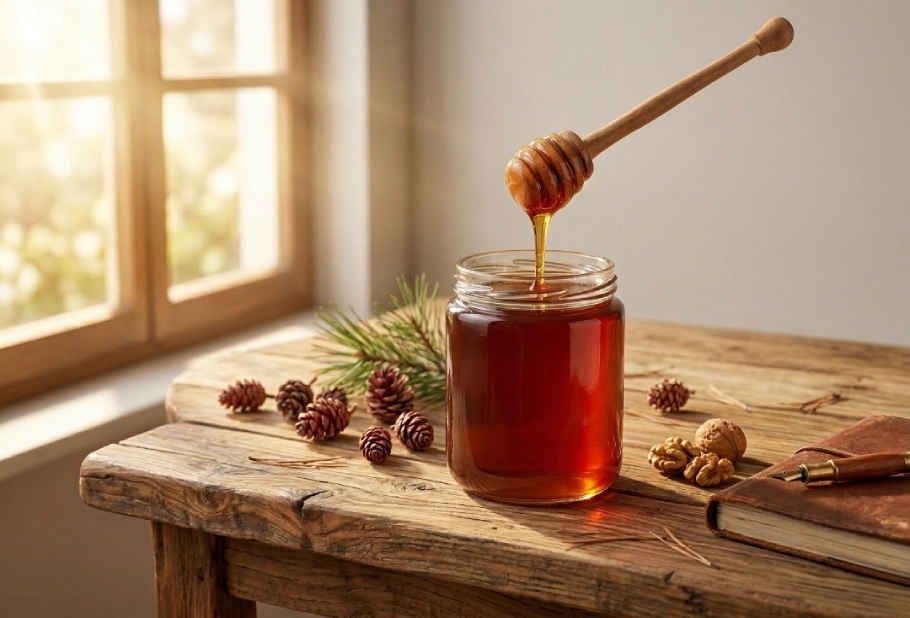
The most distinctive feature that sets pine honey apart from floral honeys and their counterfeit derivatives is its color. Pine honey has a much darker brown or reddish hue than floral honeys. When held up to the light, it presents a clear and dark sheen, not cloudy. Its smell is more reminiscent of pine forests, resin, and fresh woody notes than a floral perfume. If you detect an excessively sweet or artificial caramel smell in the honey, this may be a sign that sugar has been added.
In terms of consistency, the fluidity of real honey is crucial. High-quality pine honey stretches like a continuous thread when strained from a spoon and, when poured onto a plate, instead of spreading immediately, it clumps together to form a small mound. While common tests like “honey doesn’t burn” or “it doesn’t disintegrate when placed in water” offer clues, they don’t provide a definitive answer. However, the taste of real honey should leave a slight burning sensation in the throat while providing a characteristic, persistent aroma on the palate, rather than an artificial, sugary aftertaste.
Analysis Report Reading: What Do Proline Value and Diastase Number Indicate?
Sensory analyses can sometimes be misleading; therefore, the most accurate results are found in laboratory analysis reports. The two most critical values to look at to understand the quality of honey are “Proline” and “Diastase”.
- Proline Value: According to the Turkish Food Codex, the amount of proline in honey should be at least 300 mg/kg; however, in high-quality and “raw” honey, this value is expected to be 500-800 mg/kg and above. Honey with a high proline value is both proof of authenticity and an indicator of the amino acid richness known as the benefits of pine honey.
- Diastase Number: Indicates the enzyme activity in the honey. If the diastase number is low, this indicates that the honey has been exposed to high heat (pasteurization) or is very old. “Raw” honey that has not undergone heat treatment has a high diastase number, meaning that the honey has retained its vitality and healing properties.
Analysis reports also include a C4 sugar test (for added corn or cane sugar) and an HMF value (indicating the freshness of the honey and whether it has been heat-treated) to certify its purity.
Make the Most Natural Choice for Your Health
At Cahter Organik, we embrace a production philosophy that respects the labor of bees and the balance of nature. With our unprocessed, additive-free, and pure honey varieties, we offer not only taste but also trust, quality, and naturalness to your tables. Discover Cahter Organik honey varieties and natural bee products now.
Frequently Asked Questions
Does pine honey crystallize? (Crystallization Problem)
Pine honey is much more resistant to crystallization than flower honey and can maintain its liquid form for years. The main reason for this is its low glucose and high dextrin content, which is the answer to the question, “How does pine honey form?” If it freezes slightly after a long time, this does not indicate that the honey has spoiled; it shows that it is a natural honey that has not been heat-treated.
Does pine honey cause weight gain?
Pine honey, which has a lower glycemic index than refined sugar, does not directly cause weight gain when consumed in moderation. On the contrary, thanks to its metabolism-boosting properties, which are among the benefits of pine honey, it can be used as a healthy energy source in diets, provided that 1-2 teaspoons are not exceeded daily. It helps prevent sugar cravings by increasing the feeling of fullness.
When should pine honey be given to babies?
Honey is not suitable for babies under 1 year old due to the natural spores it contains and should not be given to this age group. Babies’ still immature digestive and immune systems cannot cope with the spores that can naturally be found in honey. After children turn one year old, you can gradually start adding pine honey to their diet, after consulting your doctor.