When we talk about the continuity of life on Earth, one of the first creatures that comes to mind is bees. Although they are generally known only as honey-making creatures, we are actually talking about a huge family with more than 20,000 different species worldwide. These hardworking creatures, which maintain the balance of the ecosystem, are the architects of a large part of the food that comes to our tables by pollinating plants. Let’s get to know these silent workers of nature and their amazing world more closely.
The Most Well-Known Honey Bee (Apis Mellifera) Races
Honey bees have undergone a process of adaptation spanning thousands of years to survive in different climate zones around the world, developing diverse biological characteristics. This diversity ensures the preservation of the unique flora structure of their regions through pollination. Shaped by natural selection, these races form the strongest biological foundation for the continuity of the ecosystem and the transmission of biological heritage from generation to generation.
Italian Bee: Efficient Workers Known for Their Calmness
One of the most widely used beekeeping breeds in the world, the Italian bee is known for its yellowish color and docile nature. Its ability to work with beekeepers makes it quite easy. They have the ability to multiply rapidly in the spring and can collect nectar from very large areas. However, a weakness of this breed is its high honey consumption in winter; therefore, careful management is required in regions with harsh winters.
Carniolan Bee: Cold-Resistant and Fast-Reproducing Breed
Originating from Central Europe, the Carniolan bee is distinguished by its gray-toned hairs. Its most distinctive feature is its ability to awaken very quickly from hibernation and rapidly expand its colony. This allows for maximum yield, especially from early spring flowers. Their resistance to adverse weather conditions makes them an ideal choice for high-altitude and variable-climate regions.
Caucasian Bee: Long-Tongued Mountain Bee That Collects Abundant Propolis
Originating from the rugged mountains of the Caucasus, this breed is known for its ability to reach nectar in deep flower tubes inaccessible to other bees. They are also famous for using large amounts of propolis to protect their hives. While they have a docile character, their tendency towards robbing and excessive propolis use can sometimes be challenging for beekeepers.
Anatolian Bee: A Native Breed Adapted to Anatolia’s Harsh Climate
A part of our geography for thousands of years, the Anatolian bee is a true master of survival. It has adapted to all kinds of extreme conditions, from the scorching heat to the freezing cold of Anatolia. Its ability to use scarce resources efficiently is highly developed, and it can protect and maintain its own colony without external intervention. These native bee varieties are particularly familiar with the region’s unique plant flora, playing a major role in the production of high-quality local honey.
Other Winged Creatures of Nature: Wild and Solitary Bee Species
The largest group among the various types of bees on Earth are actually solitary species. These bees do not produce or store honey; therefore, they have no hives or honey reserves to protect. This generally makes them docile and human-friendly creatures.
Bumblebees: The Hidden Heroes of Agriculture
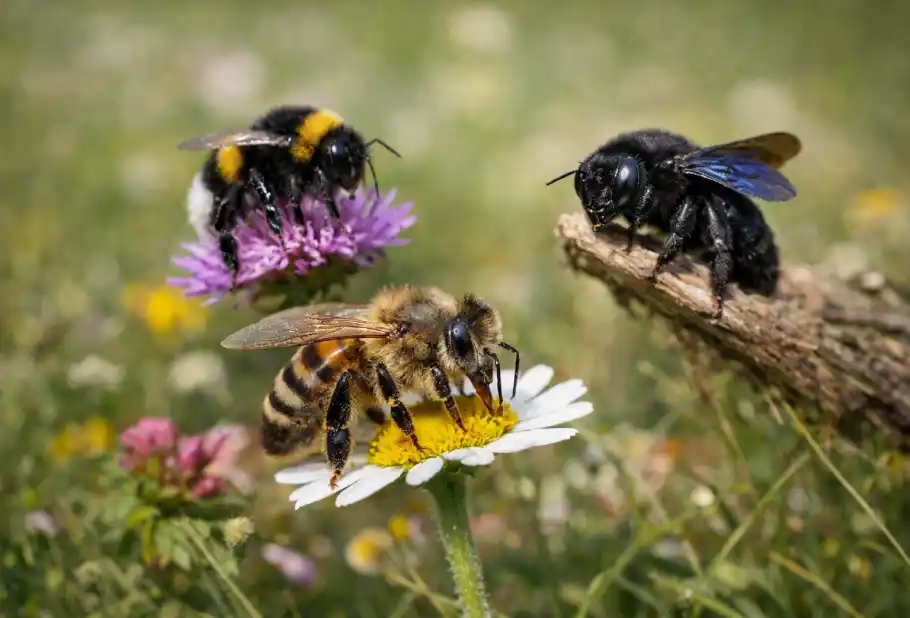
Known for their large, hairy bodies, bumblebees are invaluable for agricultural productivity. They can carry pollen even in cool, windy weather when other bees hesitate to flap their wings. Their greatest skill is “sonication,” or pollen dispersal through vibration. When they enter a flower, they vibrate their chest muscles to release pollen; this is an indispensable method, especially for pollinating plants like tomatoes and eggplants.
Carpenter Bees: Giants That Nest in Wood
Generally noticeable for their large bodies and glossy black color, carpenter bees get their name from the way they build their nests. With their strong jaws, they carve tunnel-like nests into dried tree trunks or pieces of wood. Unlike honeybees, they don’t form colonies; each female prepares her own nest and raises her young there. They may look intimidating from the outside, but they are quite calm creatures unless disturbed.
Mason Bees: Solitary Workers That Live Without Colonies
Mason bees are a species that emerge in the earliest of spring and can be even more efficient than honey bees in pollinating fruit trees. They don’t have hives; instead, they use ready-made cavities such as tree hollows, reeds, or crevices in rocks. They get their name because they use mud and clay like mortar when building their nests. They are perhaps the most peaceful of all bee species and characteristics; they almost never use their stingers and focus entirely on collecting pollen.
Social Hierarchy and Division of Labor Within a Hive
Order within a hive is based on a strict hierarchy and communication. A hive’s survival depends on performing every task on time, from cleaning and feeding to ventilation and defense. This social structure comprises three basic classes, each with completely different lifespans and responsibilities.
Queen Bee: The Sole Ruler and Source of Reproduction in the Hive
The queen bee, the heart and sole mother of the hive, is the only individual ensuring the colony’s continuity. Easily distinguishable by her longer and more impressive body than other bees, her task is to keep the colony’s population fresh by laying approximately 1500 to 2000 eggs per day. Through the special pheromones she secretes, she controls the overall peace, work motivation, and order of the hive.
Worker Bees: From Cleaning to Defense, the Burden Rests on Their Shoulders
Worker bees, the largest population in the hive, are actually female but do not have reproductive capabilities. Their lives are like a “career ladder” that changes with age. In their early days, a young worker bee is concerned with cleaning the hive and feeding the larvae, while as they age, they take on tasks such as hive repair, honey ripening, and guarding the entrance. In their final years, they begin the most demanding task: foraging; that is, carrying nectar, pollen, and water from outside. Workers, the most selfless class of bees, work so hard during honey season that they often only survive for a few weeks.
Drone Bees: The Quiet Dwellers of the Hive Whose Only Job is Reproduction
The largest members of the hive, drone bees neither collect nectar nor defend the hive because they don’t even have stingers. Their sole and primary purpose is to mate with a new queen bee, ensuring genetic diversity and the continuation of the species. During spring and summer, they live peacefully in the hive and are fed by worker bees. However, in the autumn when resources are scarce, they are driven out of the hive by worker bees to conserve the colony’s winter reserves.
The Critical Roles of Bees in the Ecosystem
The presence of bees in nature forms the most delicate link in a biological chain. The health of a bee population in a region determines the quality of all life in that region. Their greatest contribution is their role as carriers, facilitating communication and reproduction between plants.
Pollination and Food Security
Approximately one-third of the world’s agricultural production depends on pollination by bees. Fruits, vegetables, and oilseeds develop and produce seeds thanks to bees carrying pollen from flower to flower. If bees did not carry out this pollination, the production of many staple foods we consume today could come to a standstill. This demonstrates the immense importance of protecting bees for maintaining global food security.
Their Role in Biodiversity Conservation
Bees also pollinate thousands of species of flowering plants and trees in nature. These plants provide both shelter and food for birds, small mammals, and other insects. Therefore, bees are a cornerstone of biodiversity. Their presence indirectly contributes to the enrichment of vegetation, preventing erosion and conserving water resources.
Dangerous and Aggressive Bee Species: Which Ones Should You Stay Away From?
Most bees prefer not to use their stingers unless they feel a direct threat, as stinging is often a fatal form of defense for honey bees. However, some bee species can react much faster with a colony-protecting instinct and may adopt a more aggressive stance to ward off intruders.
African Honey Bee (Killer Bees)
Known in popular culture as “killer bees,” African honey bees are actually a species that emerged from the hybridization of European and African bees in a laboratory environment. Although they are physically very similar to normal honey bees, their character is quite different. Their most distinctive feature is their ability to detect threats approaching their hives from much further away and to attack in much larger groups, pursuing them over long distances. Because they react strongly even to the slightest disturbance, extra caution is necessary in areas where this species is found.
Wasps and Yellowjackets: Predatory Species
Wasps and Yellowjackets are biologically distinct from honeybees because they are predatory species that feed not only on nectar but also on other insects.
- Wasps: They are quite large and can become aggressive if you get too close to their nests. Their most important distinguishing feature is that their stingers are not serrated; this allows them to sting repeatedly without dying, unlike honeybees.
- Yellowjackets: They usually nest underground or in wall cavities. Especially towards the end of summer, their interest in sugary and protein-rich foods increases, leading to more frequent encounters with people in picnic areas.
If their nests are crossed or they are disturbed, they can attack quickly and en masse.The role of these species in nature is actually to control harmful insect populations, so they also play a role in the ecosystem. However, nests built very close to settlements can pose a risk. When encountering these wasps in nature, avoiding sudden movements and slowly moving away is generally the safest approach.
The Pure Power of Nature on Your Table with Cahter Organic
At Cahter Organic, with a production philosophy that respects the awe-inspiring labor of bees and the pure cycle of nature, we bring the most natural honey, filtered from the high plateaus of Siirt, to your tables with all its healing properties and purity, without any heat treatment. If you too want to make a choice in favor of naturalness, you can discover the world of Cahter Organic today.